
A missing tooth rarely stays a small problem for long. Beyond the gap in your smile, it can change how you bite and chew, put extra pressure on nearby teeth, and let the jawbone underneath slowly shrink. According to most dentists, replacing a missing tooth early can prevent many of these issues before they start.
Dental implants and dental bridges are the two most common ways to fill that gap, and both can restore a natural-looking, fully functional tooth. However, they work in very different ways, involve different timelines, and carry different long-term costs. The best choice comes down to your oral health, your budget, how quickly you need results, and what you want your smile to look like ten or twenty years from now.
What Is a Dental Implant?
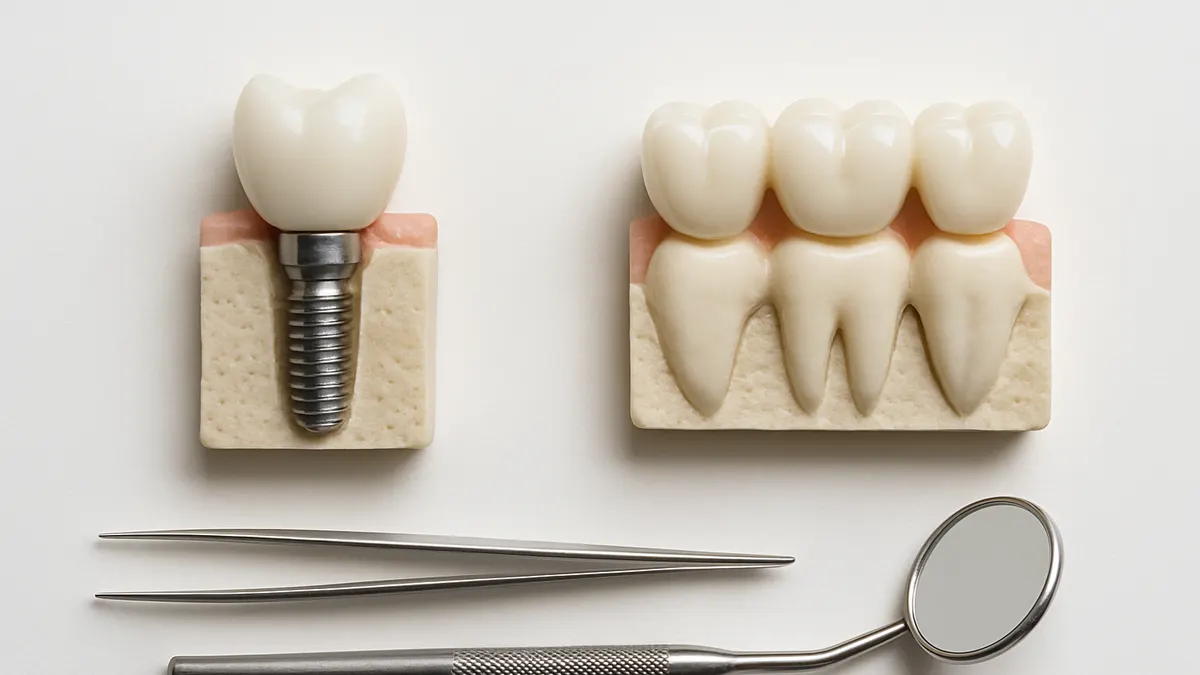
A dental implant replaces a missing tooth from the root up. A small titanium post is placed directly into the jawbone, where it fuses with the bone over several months in a process called osseointegration. Once the post has fully integrated, a connector piece called an abutment is attached, followed by a custom-made crown that sits on top. Because the post takes over the job the natural tooth root once did, an implant tends to look, feel, and function much like a real tooth, and it stands on its own without relying on the teeth next to it.
What Is a Dental Bridge?
A dental bridge fills a gap by anchoring a replacement tooth, called a pontic, to the healthy teeth on either side of the space. In a traditional bridge, those neighboring teeth are reshaped and fitted with crowns that support the pontic in between. Other versions include the cantilever bridge, which uses only one supporting tooth, the Maryland bridge, which bonds a framework to the back of adjacent teeth, and the implant-supported bridge, which rests on implants rather than natural teeth. In each case, the goal is the same: restore a natural bite and a complete-looking smile without leaving the space open.
Dental Implant vs Bridge: Key Differences
Implants and bridges both close the gap left by a missing tooth, but they differ in several practical ways that are worth weighing before you decide.
| Factor | Dental Implant | Dental Bridge |
| Treatment process | Minor surgery to place the post, followed by a healing period before the crown is attached | Neighboring teeth are reshaped and fitted with crowns to support the replacement tooth |
| Appearance | Custom crown blends with the gumline for a natural look | Custom crown blends well, though the gum tissue underneath isn’t stimulated the way a root does |
| Durability | Can last 20+ years, often a lifetime, with good care | Typically 5 to 15 years before replacement is needed |
| Cost | Higher upfront investment | Often lower upfront cost |
| Treatment time | Several months from placement to final crown | Often completed in two to three visits over a few weeks |
| Maintenance | Brush and floss as you would a natural tooth | Requires a floss threader or water flosser to clean beneath the replacement tooth |
| Effect on neighboring teeth | No impact on adjacent teeth | Requires reshaping and crowning healthy neighboring teeth |
| Jawbone preservation | Preserves bone by mimicking the tooth root | Does not prevent bone loss in the missing-tooth area |
Dental Implant vs Bridge: Which Lasts Longer?
With proper placement and good oral hygiene, a dental implant can last 20 years or longer, and many patients never need to replace one at all. A dental bridge, by contrast, typically holds up for 5 to 15 years before the supporting crowns or the pontic need attention. Longevity for either option depends on factors like how well you keep up with daily brushing and flossing, whether you grind your teeth, and how consistently you attend dental checkups. Regular visits let your dentist catch small issues, like a loosening crown or early gum recession, before they become bigger problems.
Dental Implant vs Bridge: Which Looks More Natural?
Both options use a crown that is custom-shaded and shaped to match your surrounding teeth, so at a glance the difference in appearance is often minimal. Where implants tend to have an edge is at the gumline. Because the implant post replaces the root, it continues to support the surrounding bone and gum tissue the way a natural tooth would, which helps the crown keep a natural contour over time. A bridge’s pontic sits above the gum rather than through it, so some patients notice subtle changes in that area as the years go on, particularly if bone loss develops underneath.
Dental Implant vs Bridge: Which Is Better for Your Oral Health?
An implant’s biggest oral health advantage is that it preserves the jawbone. The titanium post provides the same stimulation a natural tooth root would, which helps prevent the bone from thinning in that area. A bridge, on the other hand, depends on the two neighboring teeth for support, which means healthy tooth structure has to be reshaped to hold the crowns, and the bone under the missing tooth isn’t preserved the same way. That said, an implant does require enough healthy jawbone and gum tissue to support the post, so patients with significant bone loss may need a bone graft first, or may find a bridge to be the more practical option in the short term.
Dental Implant vs Bridge Cost
The cost of either treatment depends on several factors, including the number of teeth being replaced, the materials used for the crown, whether a bone graft or extraction is needed beforehand, and your location. Implants generally carry a higher upfront cost because of the surgical placement and healing period involved, while bridges tend to have a lower initial price tag. That gap narrows over time, since a bridge is more likely to need replacement within a decade or two, while a well-placed implant can go decades without additional work. Many dental insurance plans offer partial coverage for one or both procedures, and financing options are often available, so it’s worth reviewing this guide to dental implant insurance and financing and speaking with your dental office about what applies to your specific plan before ruling either option out on cost alone.
Pros and Cons of Dental Implants
Pros:
- Long-lasting solution that can last decades with proper care
- Helps preserve jawbone density in the area of the missing tooth
- Does not require support from neighboring teeth
- Looks, feels, and functions like a natural tooth
Cons:
- Higher initial cost in many cases
- Longer overall treatment and healing period
- Requires a minor surgical procedure
- Not every patient qualifies without additional treatment, such as a bone graft
Pros and Cons of Dental Bridges
Pros:
- Usually faster to complete than implant treatment
- Restores chewing function and appearance effectively
- Often has a lower initial cost
- Does not involve implant surgery
Cons:
- Requires reshaping and crowning healthy neighboring teeth
- Does not prevent bone loss in the missing-tooth area
- May need to be replaced sooner than an implant
- Requires extra care, like a floss threader, to clean underneath the pontic
Who Is a Good Candidate for a Dental Implant?
You may be a good candidate for a dental implant if you have one or more missing teeth, enough jawbone density to support the post, and healthy gums free of active gum disease. Good overall oral hygiene habits and a willingness to go through several months of healing before the final crown is placed also matter, since implants are a longer-term investment in both time and results.
If you’re in the Bucks County area, Dental implant services near Southampton, PA can help determine whether you meet these criteria after an in-person exam.
Who May Benefit From a Dental Bridge?
A dental bridge tends to be a good fit for patients who want a faster path to a restored smile, have healthy neighboring teeth capable of supporting crowns, or aren’t currently candidates for implant surgery due to bone loss or other health factors. It’s also a reasonable choice for anyone who would rather avoid a surgical procedure altogether and is comfortable with a treatment that may need to be replaced again down the road.
Dental Implant or Bridge: How Do You Choose?
Start by considering your current oral health, including how much jawbone and gum tissue you have in the area of the missing tooth. Think through your timeline: are you looking for the fastest possible fix, or are you willing to invest several months for a longer-lasting result? Budget matters too, both the upfront cost and how that cost compares over ten or twenty years. Finally, think about your long-term goals for the tooth and how much maintenance you’re willing to commit to.
If you’re also weighing how these compare to other replacement methods, comparing implants with other tooth-replacement options can help round out the picture. In the end, the clearest path forward is a conversation with your dentist after a full examination, since they can factor in details an article alone can’t account for.
Find the Right Tooth Replacement Option at Miracle Dental Center
Dental implants and dental bridges both restore the look and function of a missing tooth, but they get there in different ways. Implants tend to last longer and preserve jawbone, while bridges are often faster and less expensive upfront. Neither option is universally better, since the right choice depends on your oral health, budget, and how you want to invest in your smile long-term.
The team at Miracle Dental Center helps patients throughout Bucks County, including Feasterville, Richboro, Holland, Langhorne, and Newtown, weigh these options with a personalized evaluation. Schedule a consultation to find out which option, implant or bridge, fits your specific situation.
Frequently Asked Questions
Neither is universally “better.” Implants tend to last longer and preserve jawbone, while bridges are often faster and less expensive upfront. The right choice depends on your oral health, timeline, and budget.
Implants typically last 20 years or longer with good care, while bridges usually last 5 to 15 years before needing replacement.
In most cases, yes, a bridge has a lower upfront cost. Since bridges are more likely to need replacement over time, though, the long-term cost gap can be smaller than it first appears.
Both use custom-shaded crowns that blend with surrounding teeth, but implants tend to maintain a more natural gumline appearance over time since they support the bone the way a natural root does.
Implant placement involves minor surgery and a longer recovery, while a bridge is typically less invasive since it doesn’t require surgery. Both procedures are usually manageable with local anesthesia and standard aftercare.
Yes, a traditional bridge is commonly used to replace a single missing tooth using the two neighboring teeth for support.
Not always. Implants require enough healthy jawbone and gum tissue to support the post. Patients with significant bone loss may need a bone graft first, or may be better suited to a bridge.
The clearest answer comes from an in-person exam, where your dentist can evaluate your jawbone, gum health, and goals before recommending the option that fits your situation.